Case study · Artera · Health tech
One place for every message
Turning a multi-system investigation into a single search, so hospital staff could see every message a patient received. I stepped in hands-on to ship it in time for Heartbeat, our customer conference.
The problem
Staff couldn’t answer a simple question: did the patient get the message?
Health systems were fielding more than 40 communication-related inquiries every month. Each one slowed staff down and chipped away at patient satisfaction.
The questions were always some version of:
- Was the appointment reminder, confirmation or intake form actually sent?
- Why did a patient get a message about an appointment that was canceled?
- Why didn’t a patient hear anything about an upcoming appointment?
- Why is this patient getting so many texts and calls?
The answer was scattered
Staff had to open several systems to piece together what a patient had received. Even inside Artera, communication records lived in different parts of the product. And many messages went out through third-party vendors, so part of the history was invisible to us entirely.
A simple question had become an enterprise workflow
Answering one patient question meant logging into several systems, checking multiple areas of Artera, and still missing whatever vendors had sent. A yes-or-no question turned into an investigation, often with the patient waiting on the phone.
Chapter 1
Step in where the team needed it
This project landed with a team that usually focused on platform work: APIs, infrastructure, and pulling in messages from sources outside Artera.
That work had never needed an embedded designer, so the team didn’t have one. A staff-facing feature shouldn’t ship without design, so I embedded myself in the team for this project as its hands-on lead designer. I worked directly with the Director of Product Management and the engineers, which kept decisions fast and close to the code.
We had about five months to go from design to launch, with Heartbeat as the fixed date.
Chapter 2
Design one view of every message
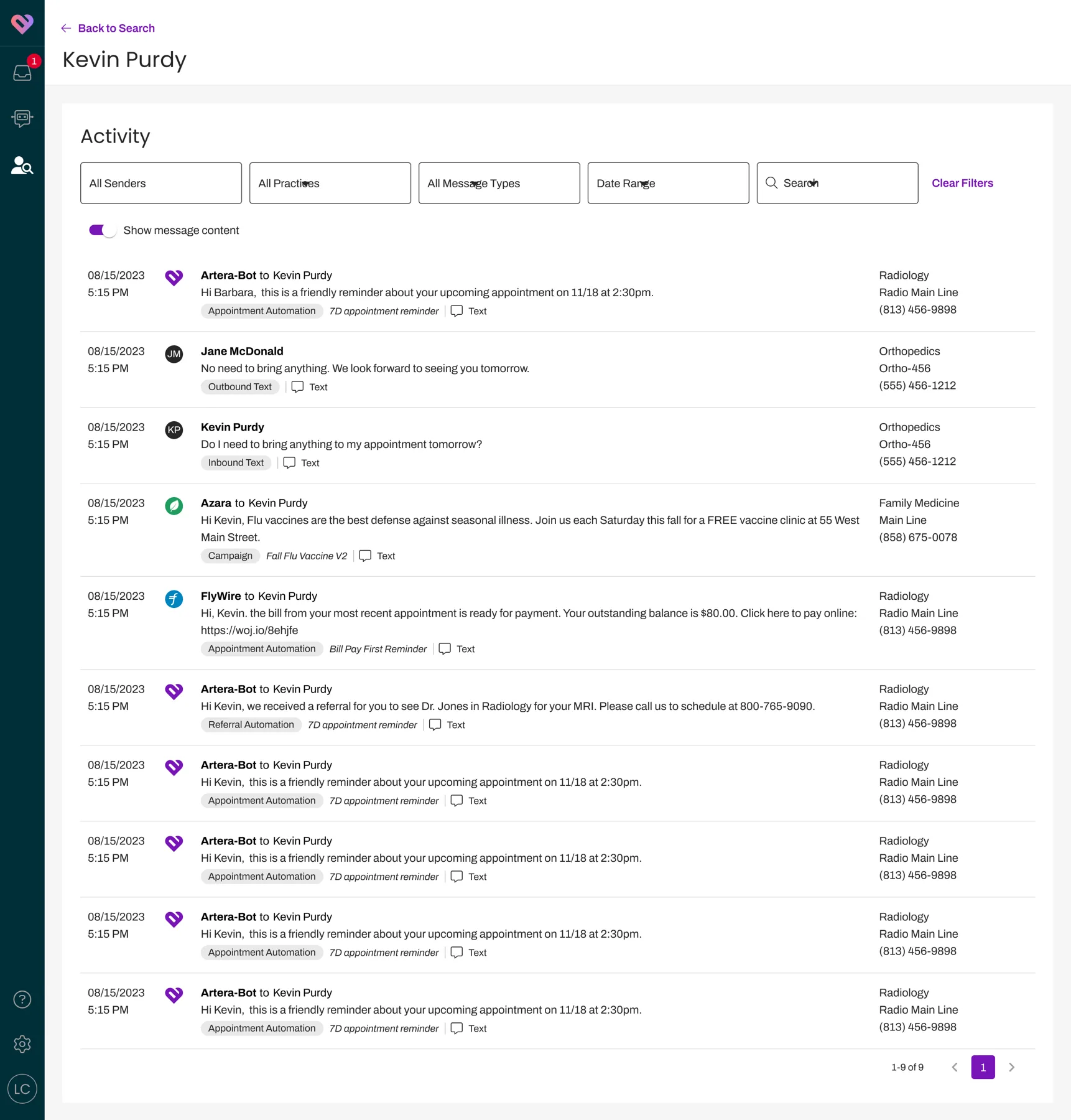
The goal was simple to state: one place where staff could see everything a patient had been sent, no matter the channel or the system that sent it.
Simple on purpose. We kept the solution no bigger than the problem. Staff didn’t need a reporting tool. They needed to answer one question quickly. So the design came down to one search, one feed per patient, and only the filters that help find a specific message.
- Every channel in one timeline. Text, email and voice messages appear together in a single activity feed for each patient, in the order they were sent.
- Find any patient fast. Staff can search by patient name or ID, so they can answer a question while the patient is still on the phone.
- Vendor messages included. Communications sent by third-party vendors through Artera’s APIs show up in the same history, so staff aren’t left guessing about what came from somewhere else.
- Filters for real troubleshooting. Staff can narrow the feed by date, message type and practice to find the one message in question.
Chapter 3
Ship it, then measure it
We released Unified Communication History to general availability on May 21, 2024, in time for Heartbeat, Artera’s annual customer conference.
Because we’d set up product analytics before launch, we could watch adoption from day one instead of guessing at it. Customers noticed right away. During a customer webinar, one attendee wrote in the chat:
“Love the universal patient search feature! Very helpful for troubleshooting instances when patients state they either did or did not receive appointment reminders, received a random text, etc.”Webinar attendee
What changed
Most customers picked it up in the first month.
Of customers adopted it
Within one month of release.
Of customer accounts
Used it daily.
Of all named users
Across those customers used it daily.
- Faster answers to the same 40+ monthly inquiries. The questions kept coming, but staff could resolve each one from a single place instead of several systems.
- Better visibility into patient communication, so health systems could respond faster and keep patients happier.
- It launched on time for Heartbeat and became a core part of Artera’s next-generation platform.
What we learned
The first version answered the question. The next ones widen who can ask it.
- Vendor messages need design attention too. Messages from outside vendors don’t always follow Artera’s standards. Inconsistent formatting and repeated messages made the feed harder to read, and future versions need to account for vendor branding.
- Coverage is the next ceiling. Many health systems use 12 or more vendors, and not all of them integrate with Artera. We started exploring ways to bring in data from systems that don’t connect through our APIs.
- The top request was access. At launch, only Admin (Enterprise) users could see the unified view. The most requested change was opening it to Managers and Staff, while keeping permissions tight enough to protect patient confidentiality.
Close
This wasn’t a big redesign.
Staff asked the same painful question dozens of times a month, and answering it meant stitching together several systems. We turned that into one search and one feed, and kept it no bigger than the problem.
The team that owned it focused on platform work and had no embedded designer, so I embedded myself for the project. 82% of customers using it in the first month says the simple version was the right one.
Also read: One system of record, not one more tool
Embedded eSignature for law firms, starting with the one document every case needs.